


How Tariffs and Global Instability Are Reshaping EMS Manufacturing
By Sean Balevre
Scott Electronics Inc.


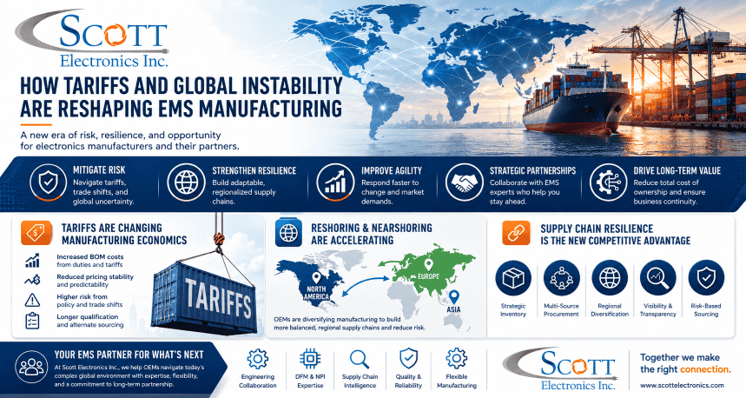
The Electronics Manufacturing Services (EMS) industry has always operated in a fast-moving global environment. But over the past several years, tariffs, geopolitical tensions, supply chain disruptions, and economic uncertainty have fundamentally changed how OEMs and EMS providers approach manufacturing strategy.
What was once primarily a cost-driven decision has evolved into a much broader conversation around resilience, flexibility, risk mitigation, and long-term supply chain stability.
For OEMs, the question is no longer simply:
“Where can we manufacture cheapest?”
Today, the better question is:
“Where can we manufacture most reliably, strategically, and sustainably?”
That shift is reshaping the EMS landscape worldwide.
The End of the “Lowest Cost Wins” Era
For decades, global electronics manufacturing was largely optimized around labor arbitrage and offshore production. China became the dominant hub for PCB assembly, component sourcing, and high-volume electronics manufacturing because it offered scale, speed, and cost advantages.
However, recent events exposed the vulnerabilities of highly concentrated global supply chains:
- U.S.–China tariffs
- Pandemic-related shutdowns
- Semiconductor shortages
- Shipping bottlenecks
- Regional conflicts
- Export controls and trade restrictions
- Rising logistics costs
- Currency instability
These disruptions forced OEMs to rethink how much risk they were carrying in their supply chains.
Today, resilience often outweighs lowest-piece-price manufacturing.
Tariffs Are Changing Manufacturing Economics
Tariffs have significantly altered the cost structure of electronics manufacturing.
Section 301 tariffs on Chinese electronics imports introduced additional duties on many electronic assemblies, PCBs, semiconductors, and related components. Some categories have seen tariffs ranging from 25% to even higher levels depending on the product type and country of origin.
For OEMs, these changes create several challenges:
Increased BOM Costs
Tariffs directly increase the landed cost of:
- PCB assemblies
- Semiconductors
- Passive components
- Metal enclosures
- Subassemblies
Reduced Pricing Stability
Trade policy changes can rapidly impact production economics, making long-term forecasting more difficult.
Supply Chain Volatility
Companies dependent on single-region sourcing are more exposed to geopolitical and regulatory shifts.
Longer Qualification Cycles
OEMs are now qualifying secondary and tertiary suppliers much earlier in the product lifecycle.
As a result, many companies are diversifying manufacturing footprints instead of relying on a single global region.
Reshoring and Nearshoring Are Accelerating
One of the largest shifts in EMS manufacturing is the movement toward reshoring and regionalization.
Many OEMs are bringing portions of production back to North America or expanding manufacturing into:
- United States
- Mexico
- Canada
- Southeast Asia
- Eastern Europe
This doesn’t necessarily mean global manufacturing is disappearing. Instead, companies are adopting more balanced, flexible manufacturing models.
Industry experts increasingly refer to this as:
- “Right-shoring”
- “Regionalized manufacturing”
- “Distributed supply chains”
The goal is not simply lower cost — it’s improved operational resilience.
Why Domestic EMS Partnerships Are Becoming More Valuable
As global uncertainty increases, OEMs are placing greater value on domestic EMS partners that offer:
Faster Communication
Time zones matter when production issues arise.
Better Supply Chain Visibility
Local manufacturing often provides improved transparency and responsiveness.
Reduced Logistics Risk
Shorter transportation routes reduce delays and shipping volatility.
Improved Engineering Collaboration
Closer proximity between engineering and manufacturing teams improves DFM, NPI execution, and issue resolution.
Regulatory and Security Advantages
Industries such as aerospace, defense, medical, and industrial controls increasingly prioritize domestic production capabilities.
This is especially important for:
- High-mix low-volume manufacturing
- Complex assemblies
- Regulated industries
- Mission-critical electronics
EMS Providers Must Become Strategic Partners
The role of EMS providers is evolving rapidly.
OEMs no longer want manufacturers that simply “build to print.”
They want strategic partners who can help navigate:
- Supply chain risk
- Component obsolescence
- Alternate sourcing
- DFM optimization
- Inventory strategy
- Tariff mitigation
- Production transfer planning
- Lifecycle management
Modern EMS companies must now combine:
- Manufacturing expertise
- Supply chain intelligence
- Engineering support
- Risk management
- Operational flexibility
The most successful EMS partnerships today are highly collaborative and data-driven.
Supply Chain Resilience Is Replacing Just-in-Time Thinking

The “just-in-time” model dominated manufacturing for years because it minimized inventory costs.
But recent disruptions revealed how fragile lean inventories can become during global instability.
Many OEMs and EMS providers are now shifting toward:
- Strategic inventory buffering
- Multi-source procurement
- Regional supplier diversification
- Longer forecasting windows
- Risk-based sourcing models
This transition may increase short-term operational costs, but it significantly improves continuity and production stability.
Technology and Visibility Are Now Competitive Advantages
Another major trend reshaping EMS manufacturing is digital supply chain visibility.
OEMs increasingly expect:
- Real-time inventory visibility
- Supply chain analytics
- Predictive forecasting
- Traceability
- Faster risk identification
- AI-driven planning tools
In today’s environment, visibility is no longer optional — it is a competitive advantage.
EMS providers that can offer stronger data transparency and faster decision-making capabilities are becoming preferred long-term partners.
What OEMs Should Focus on Moving Forward
As global conditions continue evolving, successful OEMs will focus less on chasing the absolute lowest manufacturing cost and more on total operational value.
Key priorities should include:
Diversified Supply Chains
Avoid overdependence on any single region or supplier.
Early EMS Engagement
Involve manufacturing partners earlier during design and sourcing decisions.
Flexible Manufacturing Strategies
Build production models that can adapt quickly.
Strong DFM and Supply Chain Collaboration
Design decisions directly affect sourcing flexibility and manufacturing resilience.
Long-Term EMS Partnerships
Stable partnerships create better responsiveness, forecasting accuracy, and operational continuity.
The Future of EMS Manufacturing

Tariffs and geopolitical instability are not temporary disruptions — they are reshaping the future of electronics manufacturing.
The EMS industry is transitioning from a purely cost-focused model to one centered around:
- Resilience
- Flexibility
- Regionalization
- Transparency
- Strategic collaboration
OEMs that adapt early will be better positioned to manage risk, stabilize production, and remain competitive in an increasingly uncertain global market.
At Scott Electronics Inc., we understand that today’s manufacturing environment requires more than assembly capability alone. It requires responsiveness, engineering collaboration, supply chain agility, and trusted partnerships that help customers navigate constant change.
The companies that succeed moving forward will not necessarily be the ones with the cheapest supply chains.
They will be the ones with the smartest and most resilient ones.
Scott Electronics Inc. provides electronics manufacturing services focused on quality, flexibility, and long-term customer partnerships. Contact our team to learn how we help OEMs navigate today’s evolving manufacturing landscape.