

Faster Quotes Start With a Better RFQ Package
Comments Off on Faster Quotes Start With a Better RFQ PackageFaster Quotes Start With a Better RFQ Package
By Sean Balevre


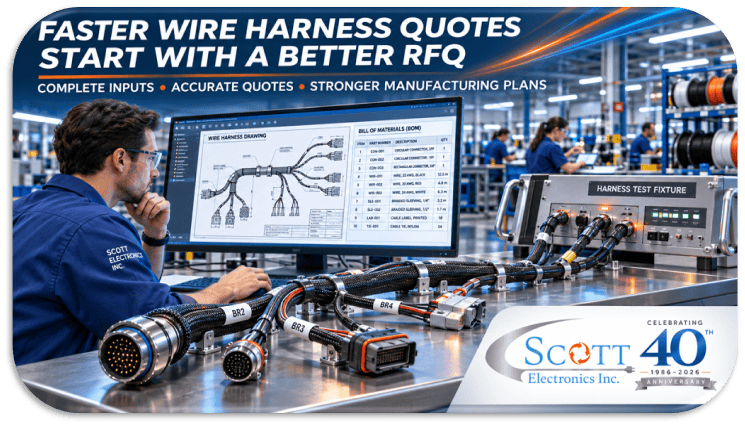
When a cable assembly or wire harness quotation takes longer than expected, the estimating process itself may not be the primary reason.
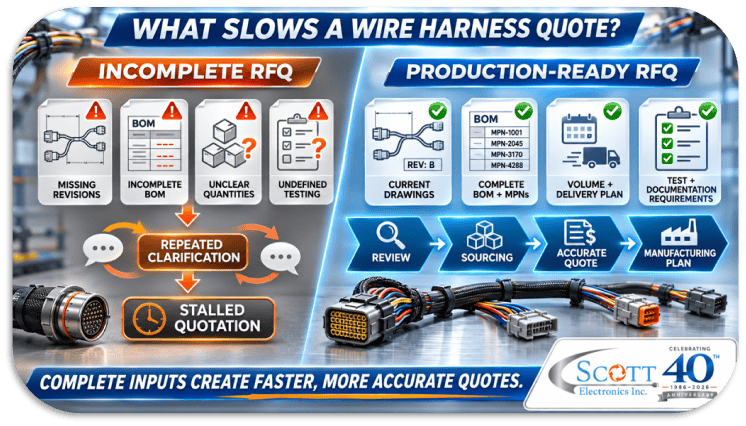
More often, the delay begins with missing information.
A 2026 survey from the Wiring Harness Manufacturer’s Association found that 70% of participating manufacturers said incomplete customer information limited their ability to prepare quotations. Seventy percent also cited delays obtaining supplier pricing and delivery estimates, while 61% reported waiting for customer clarification.
Only 17% identified estimating or engineering work itself as the primary constraint.
The survey included 23 respondents, so the results should be viewed as directional rather than representative of the entire industry. Still, they highlight a problem experienced across custom cable and wire harness manufacturing: an incomplete RFQ creates questions that must be answered before an accurate price, lead time or manufacturing plan can be developed.
Why Wire Harness RFQs Require More Than a Drawing
A custom wire harness is not simply a collection of wires and connectors.
It is a controlled electromechanical assembly that may include specific materials, approved components, critical dimensions, workmanship standards, test requirements, labeling instructions, environmental considerations and traceability expectations.
If one of those requirements is unclear, the manufacturer must either request clarification or make an assumption. Clarification extends quotation time. Assumptions can create much larger problems later, including:
- Incorrect component selection
- Unexpected material costs
- Unrealistic production lead times
- Manufacturing changes after purchase-order placement
- First-article failures
- Incomplete testing or documentation
- Delays during customer validation
- Costly redesigns or production holds
A complete RFQ package allows the manufacturer to evaluate the entire requirement—not just calculate a piece price.
Eight Areas Every Cable and Wire Harness RFQ Should Address
- Current drawings and revision control
- The RFQ should include the latest drawing revision, applicable schematics and any controlled specifications. Connector orientation, breakout dimensions, wire lengths, tolerances and critical characteristics should be clearly identified. If the assembly is changing from an existing design, the manufacturer should understand what changed and which revision is being quoted.
- Quoting from an outdated drawing can invalidate material, tooling and labor estimates.
- A complete bill of materials
- The BOM should include manufacturer names and manufacturer part numbers whenever possible.
- Descriptions such as “connector,” “18 AWG wire” or “equivalent allowed” may not provide enough information to determine pricing, availability or compliance. Different components that appear similar can have very different ratings, lead times, tooling requirements and costs.
- Customer-approved alternates, sourcing restrictions and approved-vendor requirements should also be identified.
- Approved substitutions and supply-chain flexibility
- Long-lead, sole-source and obsolete components can influence both price and delivery.
- If alternate components are permitted, that information should be included with the RFQ. If substitutions require engineering approval, the approval process should be defined.
- Early visibility allows the manufacturer to identify supply-chain risks and recommend alternatives before they affect production.
- Realistic annual and release quantities
- Estimated annual usage alone does not provide the complete demand picture.
- Manufacturers also need to understand:
-
- Prototype and pilot quantities
- Typical production release quantities
- Expected release frequency
- Requested price-break quantities
- Program duration
- Forecast visibility
- Target production dates
- A program requiring 1,000 assemblies annually in monthly releases has a different material and production strategy than the same volume released in one order.
- Workmanship and assembly requirements
- The RFQ should define the applicable workmanship standard, including the required IPC/WHMA-A-620 class or customer-specific specification.
- Requirements for crimping, soldering, shielding, grounding, splicing, torque, wire preparation and special processes should be clearly communicated.
- If a customer-specific workmanship sample or “golden unit” exists, providing it can eliminate uncertainty.
- Test and documentation expectations
- Testing can significantly affect tooling, labor, equipment and quotation accuracy.
- The RFQ should specify requirements for:
-
- Continuity and shorts testing
- Hipot or insulation-resistance testing
- Functional or optical testing
- Pull-force or mechanical testing
- Test voltages, limits and pass/fail criteria
- Test reports and data retention
- Certificates of conformance
- First Article Inspection documentation
- Material and special-process certifications
- These requirements should be included at the quotation stage—not introduced after an order has been placed.
- Environmental and regulatory requirements
- The manufacturer must understand where and how the assembly will operate.
- Important considerations can include temperature, vibration, shock, ingress protection, chemical exposure, sterilization, EMI/EMC performance, bend radius, flex cycles and torsion.
- Regulatory and program requirements may include RoHS, REACH, UL, CSA, ISO 13485, ITAR controls or other customer flow-downs.
- These requirements can directly affect material selection, manufacturing processes, documentation and
- production location.
- Over-molding, labeling and traceability
- Over-molding and strain-relief requirements should identify the desired material, geometry, color and performance criteria.
- Labeling requirements should define content, location, material and permanence. If serialization, barcodes, QR codes, date codes or lot-level traceability are required, the expected format and record-retention requirements should be provided.
- These details help ensure that the quotation reflects the complete production process.
A Better RFQ Creates a Better Manufacturing Plan
- The purpose of a complete RFQ package is not merely to receive a faster quotation.
- It helps the manufacturer develop a more accurate and scalable production strategy.
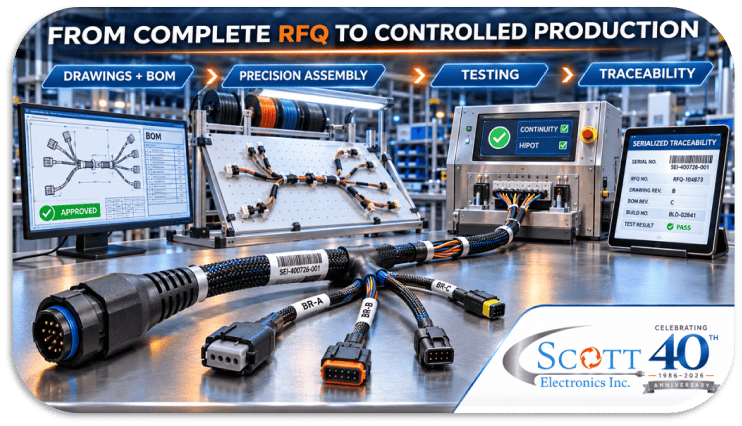
- When the technical package is complete, the manufacturing partner can evaluate component availability, tooling, labor content, testing, documentation, regulatory requirements and production capacity together. That results in fewer assumptions, more reliable lead times and a smoother transition from prototype to controlled production.
How Scott Electronics Supports the Process
Scott Electronics Inc. works with customers early in the development and sourcing process to identify missing information, manufacturing risks and opportunities for improvement.
Our capabilities include:
- Design-for-manufacturability support
- Rapid prototypes and first articles
- High-reliability cable assemblies
- Complex wire harnesses
- Fiber-optic assemblies
- Over-molding and strain relief
- Electromechanical assemblies and box builds
- Electrical and functional testing
- Serialization and lot-level traceability
- Controlled production for medical, defense, aerospace and industrial applications
A successful quotation begins with a clear understanding of the complete requirement. A successful manufacturing strategy carries that understanding through validation, production, testing and delivery.
Feel free to use the Scott Electronics RFQ READINESS CHECKLIST below before submitting your next project. It provides a practical guide to the essential information needed to prepare a responsive, accurate and production-ready quotation.
If you are developing a new assembly, transferring an existing product or qualifying an additional manufacturing source, Scott Electronics is ready to help.
Together We Make The Right Connection.
Source: “Missing Information Slows Wire Harness Quotes, WHMA Survey Finds,” Global Electronics Association, October 27, 2026.