


Complex Cable Assemblies and Wire Harnesses: Why the Right Manufacturing Partner Matters
Comments Off on Complex Cable Assemblies and Wire Harnesses: Why the Right Manufacturing Partner MattersComplex Cable Assemblies and Wire Harnesses: Why the Right Manufacturing Partner Matters
By: Sean Balevre


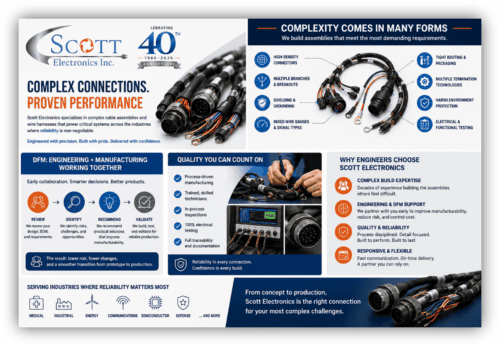
In today’s increasingly sophisticated electronic and electromechanical systems, a cable assembly or wire harness is far more than a collection of wires and connectors. It is a critical part of the product—responsible for reliably transmitting power, signals, and data while operating within demanding mechanical, electrical, and environmental constraints.
As products become smaller, more powerful, and more complex, cable assemblies and wire harnesses must keep pace. Higher circuit counts, tighter packaging requirements, specialized connectors, mixed signal and power requirements, shielding, precise routing, and demanding reliability expectations can turn what appears to be a straightforward assembly into a significant engineering and manufacturing challenge.
That is where choosing the right manufacturing partner becomes critical.
At Scott Electronics Inc., we understand the challenges associated with manufacturing complex cable assemblies and wire harnesses. Our combination of manufacturing expertise, commitment to quality, and engineering and Design for Manufacturability (DFM) support helps customers move challenging designs from concept and prototype into reliable production.
Complexity Goes Beyond the Number of Wires
What makes a cable assembly or harness “complex”?
It isn’t necessarily size or conductor count. Complexity can come from many different aspects of the design, including:
- High-density and multi-pin connectors
- Multiple connector and termination technologies within one assembly
- Tight dimensional and routing requirements
- Mixed wire gauges and conductor types
- Shielding and grounding requirements
- Twisted pairs and signal-sensitive circuits
- Branching and breakout configurations
- Sleeving, conduit, braid, heat shrink, and other protective materials
- Precise stripping, crimping, soldering, and termination requirements
- Mechanical hardware integrated into the assembly
- Specialized labeling and traceability requirements
- Electrical and functional testing requirements
- Tight packaging and installation constraints
Individually, many of these requirements are manageable. When several exist within the same assembly, however, manufacturing difficulty can increase quickly.
The challenge is not simply building the first assembly correctly. The real challenge is developing a repeatable manufacturing process capable of producing the assembly consistently and reliably throughout the product lifecycle.
Good Designs Still Need Manufacturing Expertise
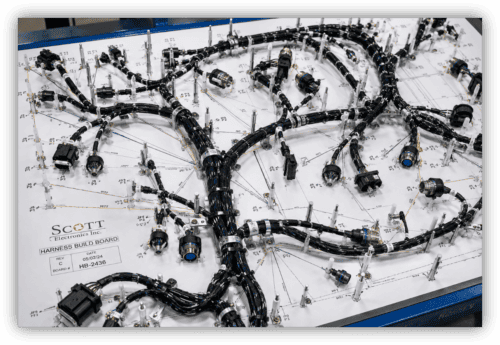
Engineers understandably design around the requirements of the finished product. But a design that works perfectly from a system perspective may still present manufacturing challenges.
A dimension that appears straightforward on a drawing, for example, may be difficult to maintain once multiple conductors, branches, coverings, and terminations are incorporated into the harness. A connector selection may satisfy the electrical requirements but create difficult assembly or inspection conditions. Routing requirements may make sense inside the final equipment but introduce unnecessary complexity during harness fabrication.
These are exactly the situations where an experienced manufacturing partner can add value.
At Scott Electronics Inc., our goal is not simply to receive a drawing and build from it. By applying manufacturing experience early in the process, we can work with engineering teams to identify potential production challenges before those challenges become costly problems.
 DFM: Bridging Engineering and Production
 DFM: Bridging Engineering and Production
Design for Manufacturability is particularly valuable with complex cable assemblies and wire harnesses.
Effective DFM does not mean compromising the engineering intent of the product. It means examining how that intent can be achieved through a manufacturing process that is practical, repeatable, inspectable, and scalable.
DFM discussions may include opportunities involving:
Component selection. Are the specified connectors, terminals, contacts, wire, and protective materials appropriate for the application while also supporting a reliable manufacturing process?
Termination methods. Are stripping, crimping, soldering, and other termination requirements clearly defined and practical to execute consistently?
Dimensions and tolerances. Are tolerances aligned with the realities of flexible cable and harness construction?
Routing and breakouts. Can branch locations, breakout lengths, and routing requirements be produced consistently?
Assembly sequence. Does the design allow an efficient and controlled manufacturing sequence?
Inspection and testing. Can critical characteristics be effectively verified before the assembly reaches the customer?
Addressing these considerations early can reduce engineering changes, rework, production delays, and unnecessary cost later.
Quality Must Be Designed Into the Process
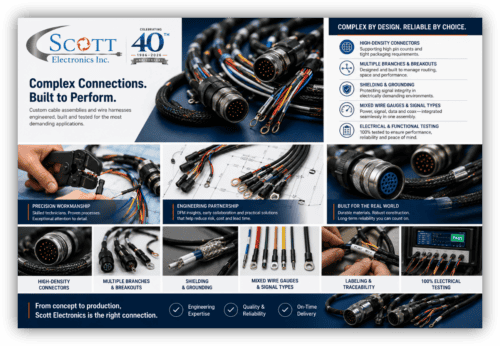
Complex assemblies create more opportunities for variation, which makes process control especially important.
Quality cannot depend solely on final inspection. By the time a completed harness reaches final test, many critical operations may already be hidden beneath heat shrink, sleeving, braid, conduit, or other protective materials.
A robust manufacturing approach therefore incorporates quality throughout the build process.
This means controlling critical operations, establishing appropriate inspection points, verifying workmanship as the assembly progresses, and performing the electrical and other testing required by the product specification.
For engineers, this distinction matters.
The objective isn’t simply to receive assemblies that pass inspection. The objective is to have confidence that the manufacturing process itself is capable of producing consistent results.
From Prototype to Production
Prototype builds provide an important opportunity to prove more than whether a design functions.
They also allow engineering and manufacturing teams to evaluate how the assembly will actually be built.
During early builds, experienced manufacturers can identify issues that may not be obvious in CAD models, schematics, bills of material, or drawings. These might include difficult termination sequences, tolerance accumulation, accessibility problems, material interactions, routing challenges, or opportunities to simplify the assembly.
Resolving these issues before production volumes increase can provide significant benefits.
A successful prototype should therefore accomplish two objectives: validate the product and help validate the manufacturing process.
That philosophy is particularly important for complex cable assemblies and wire harnesses.
Why Engineers Choose Scott Electronics
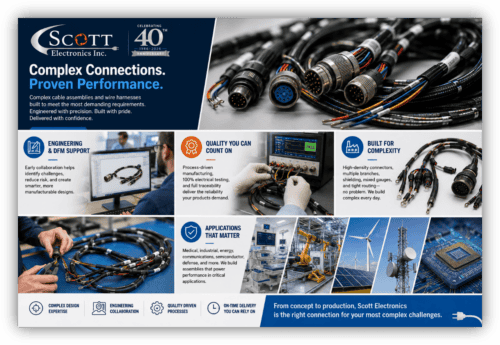 When selecting a manufacturing partner, engineers need more than manufacturing capacity. They need a supplier capable of understanding the design, recognizing manufacturing risk, communicating technical concerns, and consistently executing the finished product.
Scott Electronics Inc. brings together three capabilities that are particularly important for complex cable and harness programs:
Complex Build Expertise
Complex assemblies require experience.
Understanding how materials behave during assembly, how tolerances interact, how termination methods affect reliability, and how assembly sequencing affects repeatability comes from manufacturing challenging products every day.
Scott Electronics Inc. applies this manufacturing knowledge to help transform complex engineering requirements into controlled, repeatable production processes.
Engineering and DFM Support
The earlier manufacturing knowledge is introduced into the product-development process, the greater its potential value.
Scott Electronics Inc. works collaboratively with customers to identify manufacturability concerns and opportunities for improvement while respecting the functional requirements and engineering intent of the design.
That collaboration can help reduce risk during the transition from prototype to production.
Commitment to Quality and Reliability
A cable assembly may represent only one portion of a larger system, but its failure can affect the entire product.
For that reason, quality and reliability must remain central throughout the manufacturing process.
Scott Electronics Inc. approaches complex assemblies with the process discipline, inspection, testing, and attention to workmanship necessary for applications where dependable performance matters.
Your Cable Assembly Supplier Should Be an Extension of Your Engineering Team
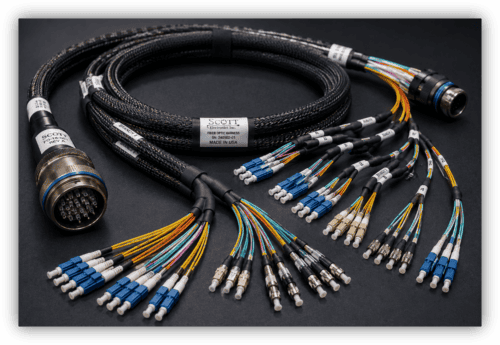
For straightforward assemblies, purchasing decisions can sometimes focus primarily on price and lead time.
Complex cable assemblies and wire harnesses require a different approach.
The right supplier should understand not only what needs to be built but also why particular requirements matter and how to manufacture them consistently.
That requires communication between engineering and manufacturing, practical DFM knowledge, disciplined process development, and a commitment to quality throughout the build.
At Scott Electronics Inc., we believe our role is to become an extension of our customers’ engineering and manufacturing teams—helping turn challenging cable and harness designs into reliable, repeatable production assemblies.
Whether you are developing a new product, working through a challenging cable or harness design, transitioning from prototype to production, or evaluating a new manufacturing partner, involving Scott Electronics Inc. early can help identify manufacturing risks and create a smoother path to production.