


E-Chains in Industrial Automation: Engineering Reliability into Motion Systems
Comments Off on E-Chains in Industrial Automation: Engineering Reliability into Motion SystemsE-Chains in Industrial Automation: Engineering Reliability into Motion Systems
By Sean Balevre
Scott Electronics Inc.


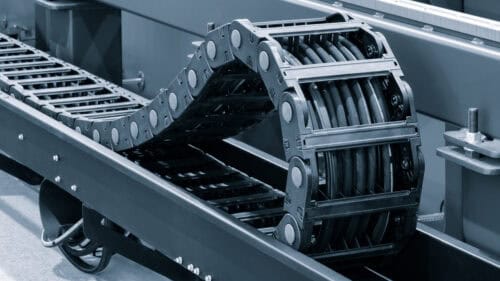
In modern industrial automation, dynamic motion systems are everywhere — gantries, Cartesian actuators, robotic transfer units, high-speed pick-and-place platforms, and automated test equipment. These systems rely on continuous-flex power, control, feedback, and pneumatic lines to function.
The weakest point in any moving system is often not the actuator or controller — it’s the cable.
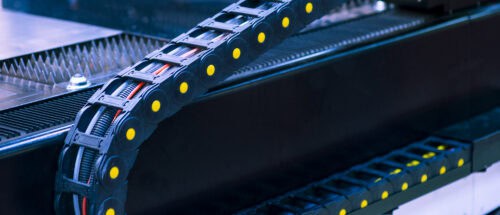
E-chains (energy chains / cable carriers) are critical mechanical components that control, guide, and protect cables and hoses in dynamic applications. When properly specified and implemented, they dramatically increase system reliability and reduce failure rates in high-cycle environments.
At Scott Electronics Inc., we provide complete industrial automation solutions — including advanced E-chain systems that support high-performance motion control applications.
What Is an E-Chain?
An E-chain is a segmented, articulating cable carrier that:
- Maintains a defined bend radius
- Constrains cable motion to a predictable path
- Prevents torsion and overextension
- Separates different cable types internally
- Protects against abrasion and debris
E-chains are commonly deployed in:
- Linear motion systems (X-Y-Z gantries)
- Servo-driven axes
- Robotics transfer systems
- CNC and precision machining equipment
- Automated material handling systems
- Semiconductor and electronics manufacturing equipment
They are particularly critical in applications with high acceleration, high duty cycle, and long travel distances.
Technical Considerations in E-Chain Applications
Proper E-chain performance depends on several engineering variables.
1. Bend Radius Control
Each cable type has a minimum bend radius specification. Exceeding this limit accelerates copper strand fatigue and insulation breakdown.
E-chains enforce consistent bend geometry across thousands or millions of cycles, which is especially important for:
- Servo motor power cables

- Encoder and feedback lines
- Hybrid power/feedback cables
- Fiber optic lines
- Pneumatic tubing

2. Dynamic Load & Acceleration
High-speed motion systems generate significant dynamic forces. Acceleration profiles directly impact:
- Chain tensile loading
- Cable sidewall pressure
- Internal friction between cables
Improperly rated carriers may experience premature link wear, increased drag force, or structural fatigue.
3. Cable Fill Ratio & Internal Separation
Overfilled E-chains increase heat buildup, friction, and mechanical stress.
Best practice includes:
- Maintaining proper fill ratios
- Separating power and signal cables
- Using internal dividers
- Securing cables with appropriate strain relief
This is particularly important in high-EMI environments where signal integrity must be maintained for:
- Servo feedback
- High-speed communication networks (EtherCAT, Profinet, etc.)
- Sensor arrays
4. Continuous-Flex Cable Requirements
Standard tray-rated or machine-tool wire is not suitable for dynamic E-chain applications.
Continuous-flex cables feature:
- Fine-strand copper conductors
- High-flex insulation materials
- Controlled lay lengths
- Reinforced shielding structures
Matching the cable construction to the motion profile significantly extends service life.
5. Environmental Factors
Industrial environments may introduce:
- Oil mist
- Abrasive dust
- Chemical exposure
- Elevated temperatures
Material selection for the carrier — polymer vs. steel — must account for these factors to prevent premature degradation.
Failure Modes in Improperly Implemented Systems
Common field issues include:
- Broken conductors from over-bending
- Shield failure causing encoder noise
- Excessive drag increasing motor load
- Chain sag in long-travel applications
- Pneumatic line kinking
These issues often manifest as intermittent faults — the most difficult type of automation problem to troubleshoot.
Proper E-chain systems significantly reduce these risks.
Scott Electronics Inc.: Advanced Motion Support
Scott Electronics Inc. supports industrial automation systems where reliability and uptime are critical. Our expertise in electromechanical systems and motion control enables us to provide complete E-chain solutions aligned with demanding industrial requirements.
We support:
- High-cycle servo-driven systems

- Multi-axis motion platforms
- Robotics integration
- Automated production equipment
- Precision positioning systems
Our approach ensures that E-chain systems are compatible with:
- PLC-controlled motion architectures
- Distributed I/O systems
- Industrial Ethernet networks
- Safety-integrated control systems
By addressing cable management as a core part of motion system performance, we help manufacturers reduce downtime, protect signal integrity, and improve long-term equipment reliability.
The Bottom Line
In high-performance automation systems, cable management is not a secondary concern — it is a critical reliability factor.
E-chains:
- Protect dynamic cabling
- Preserve signal integrity
- Reduce mechanical stress
- Improve system lifespan
- Minimize unplanned downtime
For manufacturers operating high-speed, high-cycle automation equipment, properly implemented E-chain systems are essential.
Scott Electronics Inc. delivers the technical expertise and industrial automation capability to support your motion systems — keeping your operation running efficiently and reliably.